

Blog
How Much Do Safety Courses Cost in the UAE? A Complete Price Breakdown

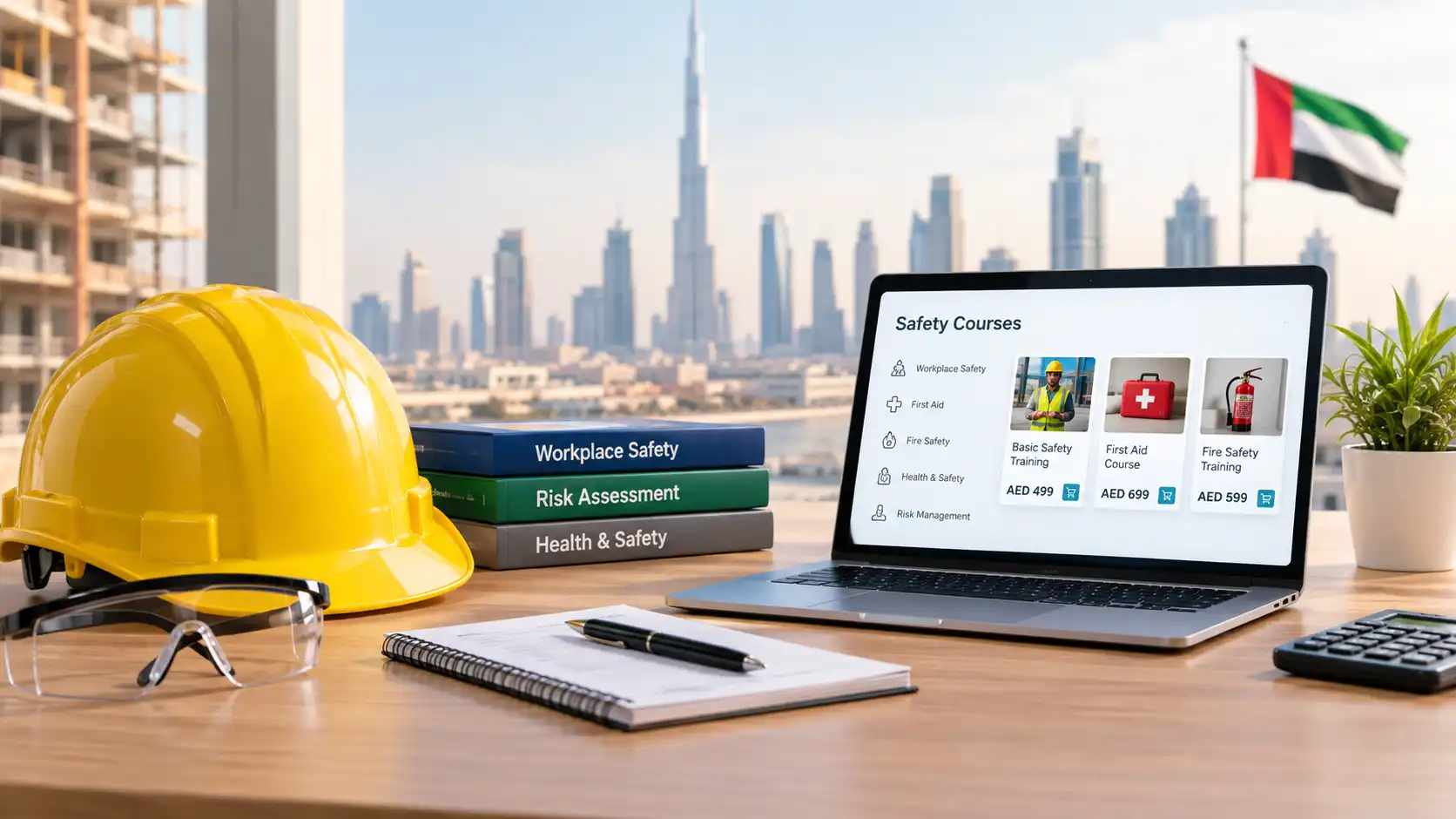
You search for a NEBOSH course in Dubai and the results range from AED 499 to AED 12,854. Both numbers are real. One is a self paced e-learning listing with no exam entry included and the other is a classroom programme with tuition, materials and awarding body fees bundled. Nobody explains the difference, so buyers either overpay or buy something that cannot produce the certificate they need. At Ahlan Safety Training Centre we quote against sixteen years of delivery across the UAE and the wider Gulf, and this breakdown shows you what the market actually charges and what sits underneath the headline price.
Why Published Safety Course Prices Are So Inconsistent
Aggregator platforms in the UAE index around six hundred health and safety courses at prices from AED 375 to AED 50,001. Any average calculated from that pool is meaningless, because the pool blends three completely different products.
Self-paced e-learning sits at the bottom. You receive content access, no live instructor, and often no exam entry. Live virtual delivery sits in the middle, with a scheduled instructor and a fixed cohort. Classroom delivery sits at the top, with venue, printed materials, in person assessment support and usually the awarding body fee bundled in. Comparing an AED 400 e-learning listing to an AED 3,200 classroom programme is comparing two different purchases that happen to share a qualification name.
The second distortion is bundling. Some quotes include the exam or unit fee and some do not. Some include the awarding body registration and some invoice it separately after enrolment. And so the only fair comparison is total cost to certificate, not the advertised figure.
Current UAE Safety Course Price Bands
The table below reflects UAE market pricing observed through August 2026 across classroom, live virtual and self paced delivery. Use the typical column when you are budgeting, because that is where most credible providers sit.
| Course | Budget or online only (AED) | Typical UAE classroom or live virtual (AED) | Premium or international provider (AED) |
|---|---|---|---|
| IOSH Working Safely, 1 day | 400 to 600 | 500 to 1,200 | up to 6,200 |
| IOSH Managing Safely, 3 to 4 days | 444 to 900 | 900 to 2,500 | 2,500 to 3,000 plus |
| OSHA 30 Hours Construction | 399 to 899 | 800 to 2,500 | up to 4,200 |
| OSHA 30 Hours General Industry | 399 to 799 | 700 to 2,200 | to 3,000 |
| NEBOSH International General Certificate | 999 to 1,800 | 2,500 to 3,750 | 4,000 to 5,000 plus |
| NEBOSH International Diploma, Level 6 | 3,250 to 5,000 e-learning | 8,500 to 9,000 plus exam fees | up to 33,000 |
| NVQ Level 3 Certificate, ProQual | not commonly offered | 2,500 to 4,500 estimated | 9,975 |
| NVQ Level 6 Diploma, ProQual | not commonly offered | 5,500 to 8,000 | 10,975 |
| ISO 45001 Lead Auditor, 5 days | not commonly offered | 3,000 to 5,000 | 5,000 to 7,000 |
| ISO 45001 Awareness, 1 day | 150 to 400 | 400 to 900 | to 1,200 |
| First Aid and CPR, 1 day | 30 to 200 | 190 to 650 | 1,000 to 2,800 |
| Fire Warden or Fire Marshal, half to 1 day | 150 to 300 | 300 to 700 per person | 700 to 2,000 |
A few reference points help you sanity check any quote you receive. Across UAE listings for the International General Certificate the average settles near AED 2,810. Safety Officer courses indexed in Dubai average AED 3,240. First aid and CPR courses average AED 658 nationally. If a quote sits far outside those anchors in either direction, ask what is included before you assume it is a bargain or a rip off.
The Costs That Do Not Appear in the Headline Price
This is where budgets break. A quote of AED 2,500 can become AED 4,200 by the time your certificate is attested and your registration is paid. Work through this list before you approve any purchase order.
- VAT at five percent. The Federal Tax Authority’s education sector guidance published in 2026 confirms that zero rating requires recognition by a UAE education authority together with an approved curriculum. Many private professional and non accredited programmes remain standard rated. Ask whether the quoted figure is inclusive.
- Awarding body unit or exam fees. NEBOSH charges per unit, and the full International General Certificate typically adds around AED 1,500 to 1,600 once administration is included. International Diploma units run roughly AED 1,150 each, and some UAE providers invoice a flat diploma exam fee near AED 3,000 separately from tuition.
- Resit fees. Budget around AED 300 per unit for a NEBOSH resit. ISO 45001 examination retakes typically run AED 600 to 1,200.
- Certificate attestation. KHDA attestation in Dubai runs approximately AED 120 plus VAT per certificate, usually within one working day. You need it for many visa and authority submissions.
- Regulator registration. Abu Dhabi’s Qudorat practitioner registration costs AED 540 per year through TAMM. Trakhees charges AED 2,100 for new Safety Advisor registration and AED 1,100 for renewal, AED 1,000 for Safety Supervisor registration and AED 1,200 for the Manager Safety Awareness Programme. These are the cost of being employable, and no course price page includes them.
- Study materials and practical add-ons. ISO 45001 materials typically run AED 200 to 800, and practical audit training add-ons run AED 1,000 to 3,000.
- Certificate delivery. Most awarding bodies now issue digital certificates as standard and charge for printed, replacement or certified copies. Confirm the position before you need a hard copy urgently.
One genuine piece of good news. Under Abu Dhabi’s Qudorat programme, international certifications are verified directly with the issuing awarding body, so no UAE attestation is required for that particular registration route. That saves both fee and turnaround time.
What Corporate and On Site Delivery Actually Costs
No provider in this market publishes corporate rates, and the reason is that group pricing is genuinely situational rather than evasive. The structure is consistent even when the numbers are not.
Corporate quotations are normally built from a per group day rate rather than a per head fee, plus trainer travel and accommodation for out of emirate delivery, plus a minimum headcount. Per head economics improve sharply above roughly eight to ten delegates, which is the point where a dedicated cohort becomes cheaper than sending people to public dates. Below that threshold, public scheduled courses almost always win on cost.
Two variables move a corporate quote more than anything else. The first is venue, since delivery at your own premises removes room hire but adds equipment logistics. The second is language, because Arabic, Urdu and Hindi delivery requires a specific trainer pool. Both are worth raising at enquiry stage rather than after the quote arrives. You can discuss group requirements directly through our contact page.
Total Cost of a Safety Career Path in the UAE
Individual course prices tell you very little. What matters is the cumulative cost of the route from entry level to management, and how quickly the salary movement repays it.
A realistic mid market path looks like this. IOSH Working Safely at around AED 800 gets you site ready. OSHA 30 Hours General Industry at around AED 1,400 adds a recognised thirty hour training record. The NEBOSH International General Certificate at around AED 3,000 plus roughly AED 1,600 in unit fees is the credential that changes your job eligibility. Emirate registration adds AED 540 to 2,100 depending on jurisdiction. That sequence totals roughly AED 7,300 to 9,400 including VAT.
The return is measurable. Professionals who complete that sequence typically move from the AED 3,500 to 5,000 band into the AED 8,000 to 12,000 band. At a conservative AED 4,000 monthly increase, the full spend repays inside three months and everything after that is compounding.
Extending to management changes the arithmetic but not the logic. A NVQ Level 6 Diploma at AED 5,500 to 8,000 or an equivalent Level 7 route maps to the Abu Dhabi Senior Practitioner tier, and an ISO 45001 Lead Auditor qualification at AED 3,000 to 5,000 opens the OSH Auditor registration category along with consultancy day rates. Both sit in the AED 12,000 to 30,000 salary territory. The cumulative career spend from zero to that point lands near AED 20,000, against an annual salary difference measured in six figures.
 How to Compare Two Quotes Properly
Price comparison in this market fails because buyers compare the wrong number. Use these five checks instead.
- Ask for total cost to certificate, including VAT, awarding body fees, materials and first attempt exam entry.
- Confirm the delivery mode in writing. Self paced, live virtual and classroom are three different products at three different prices.
- Check accreditation directly with the awarding body rather than accepting a logo on a website.
- Ask what happens if a learner fails, and at what cost. A provider confident in its pass rates will answer plainly.
- For OSHA style programmes, confirm whether you are buying a Department of Labor card or a different awarding route, because the two are not interchangeable and are often priced similarly.
Where the Cheapest Option Costs You More
Low cost e-learning has a legitimate place. It works for awareness level content, for refresher knowledge, and for large workforces where the requirement is documented training rather than assessed competence.
It fails in three situations. It fails when a client prequalification document specifies instructor led delivery, which many UAE main contractor and free zone documents still do. It fails when the qualification requires a workplace project or portfolio, because those need assessor support that budget platforms do not provide. And it fails when the certificate must be attested for a visa or authority submission, because non accredited programmes cannot be attested at all.
The cost of buying the wrong product twice always exceeds the saving on buying the right one once. Our short course range and Highfield health and safety qualifications are priced for exactly the volume awareness requirement that e-learning is often mis-sold into.
Do Safety Course Prices Differ by Emirate?
They do, though less than salaries do. Abu Dhabi listings index from around AED 400 to AED 17,444 across roughly 285 courses, and Dubai indexes around 479 courses across a similar spread. Dubai carries more provider competition, which compresses the middle of the market. Abu Dhabi carries fewer providers and a heavier compliance requirement, which supports slightly firmer pricing at the accredited end.
Sharjah and the northern emirates sit lower on venue and delivery cost, and providers based there can often deliver the same accredited programme for less. The variable that matters more than emirate is travel. A trainer despatched from Dubai to a remote site in Fujairah or the Western Region carries travel and accommodation into the quote, and that line item routinely adds more than the emirate price differential ever would.
One further factor is scheduling. Public course dates are priced on cohort economics, so an under filled date either runs at a loss or gets postponed. Providers who postpone repeatedly are usually pricing below sustainable cost, and the hidden charge you pay is a delayed mobilisation.
Questions Buyers Ask About UAE Safety Course Fees
Is the NEBOSH exam fee included in the course price?
Sometimes. UAE providers commonly bundle first attempt unit fees into the classroom price and exclude them from e-learning prices. NEBOSH charges per unit, and the total for the International General Certificate with administration lands near AED 1,500 to 1,600. Always ask for the position in writing, because this single line item is the most common source of quote to invoice variance.
Why do NVQ prices stay hidden behind a contact form?
Because NVQ qualifications are portfolio assessed rather than taught to a fixed timetable. Cost depends on assessor time, evidence volume and how long the candidate takes, so a fixed public price would either overcharge fast candidates or undercharge slow ones. UAE listings that do publish put the ProQual Level 6 route near AED 5,500, and UK providers publish around AED 10,975 equivalent. Ask specifically whether assessor and verification fees are bundled.
Are safety courses in the UAE subject to VAT?
Many are. Zero rating applies where an institution is recognised by a UAE education authority and delivers an approved curriculum. Private professional short courses and non accredited programmes generally remain standard rated at five percent. This is not a provider choice, it follows the Federal Tax Authority position, so treat any quote that stays silent on VAT as exclusive until confirmed otherwise.
Does a more expensive course mean a better pass rate?
Not reliably. Price correlates with delivery mode and venue far more than with outcome. What does correlate with pass rates is instructor contact time, assessor support on project based qualifications, and whether the provider runs structured revision before assessment. Ask about those three things rather than about price.
Can my employer claim safety training costs back?
There is no federal training rebate scheme in the UAE comparable to a levy system. What employers do recover is indirect: lower incident rates, fewer lost time injuries, better prequalification scoring on tenders, and avoidance of penalties under the labour law and emirate frameworks. Companies bidding for main contractor work frequently find that a trained and registered safety team is the difference between qualifying for a tender and being screened out of it.
Getting an Accurate Quotation
Safety training in the UAE is not expensive relative to what it unlocks. It is confusing, because pricing is quoted inconsistently and the fees that matter sit outside the headline figure. Once you compare total cost to certificate rather than advertised price, the market becomes readable.
At Ahlan Safety Training Centre we quote inclusive figures, confirm awarding body fees upfront, and tell you when a cheaper route genuinely suits your requirement. Our advisors have built training budgets for 250 corporate clients across the UAE, Oman, Qatar, Saudi Arabia, Kuwait, Bahrain and South Africa. Browse current pricing across the full course catalogue, review the OTHM Level 6 route if you are budgeting toward management, or check the latest offers before you commit to a public date.