

Blog
Your Safety Obligations Under UAE Labour Law and What MOHRE Actually Checks

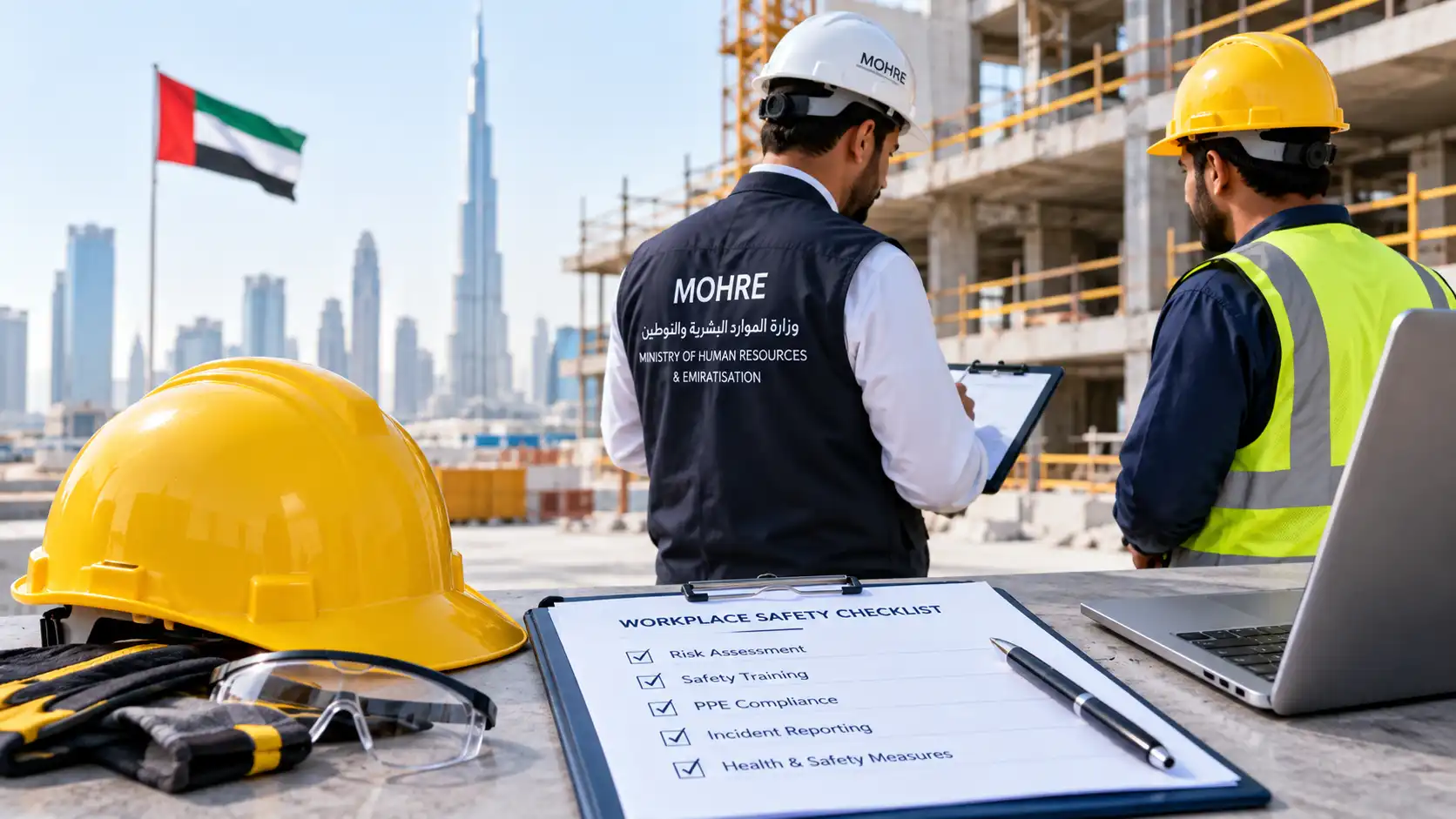
An inspector walks onto your site at 1:15 in the afternoon on a July day. Before she says hello, she looks at three things: are workers standing in direct sun, is there shade and water, and can the site manager show her the paperwork. Everything else comes after.
Employers in the UAE often know that “labour law requires safety” but cannot name the duties. So they prepare for an inspection by tidying the site the night before. That approach fails. This guide explains what the law puts on the employer, which of those duties inspectors tend to test first, and how to build a compliance routine you can defend on any day of the year.
A quick note on scope. This article summarises published requirements for a general audience. It is not legal advice, and rules change through ministerial resolutions. Confirm the current text with the Ministry of Human Resources and Emiratisation (MOHRE) or a qualified lawyer before you rely on any detail.
The Legal Framework in Plain Terms
Workplace safety in the UAE private sector sits in layers.
- Federal Decree-Law No. 33 of 2021 regulates labour relations and sets the employer’s duty to protect workers.
- Cabinet Resolution No. 1 of 2022 is the executive regulation that turns the law into operating detail.
- Ministerial resolutions add specifics such as the summer midday break and health and safety standards.
- Emirate frameworks apply on top. Abu Dhabi runs the ADOSH-SF system, and Dubai relies on municipal, civil defence and free zone rules.
- Client and sector rules raise the bar further on oil and gas, ports and major projects.
Read them as a stack. Federal law sets the floor. Local and client rules build upwards from it.
What the Law Requires From Employers
Provide a Safe Workplace and Identify Hazards
The employer must identify occupational hazards and put protective measures in place against work injuries and occupational diseases. That covers equipment safety, work procedures and hygienic conditions. Hazard identification is not a one-off. Reassess when you change equipment, processes or site layout.
Supply Protective Equipment at No Cost
Personal protective equipment and suitable protective clothing come at the employer’s expense. Handing out helmets is the easy part. You must also make sure workers wear them correctly, replace damaged items and match PPE to the task hazard.
Educate Workers About Their Job Hazards
Employers must inform workers about the hazards of their jobs and how to prevent them, and display safety signage across the workplace. A poster in English does not satisfy the duty if the crew reads Hindi, Urdu, Bengali or Tagalog. Use languages and pictures that the workers actually understand.
Provide First Aid and Medical Surveillance
First aid facilities must be available on site. Workers exposed to occupational hazards, including many in industrial and construction settings, require periodic medical examinations aimed at detecting occupational diseases early. Keep the records.
Report Injuries and Occupational Diseases
Work injuries and occupational diseases must be reported to MOHRE through the designated channels. Official guidance requires critical injuries and workplace deaths to be notified within 48 hours of the incident. Establishments with 50 or more employees must operate monitoring systems for work injuries and occupational diseases.
Appoint a Qualified Safety Officer at Scale
According to official UAE government guidance, industrial and construction establishments with 100 or more workers must appoint a qualified Occupational Health and Safety Officer to oversee hazard prevention and compliance. The word “qualified” carries weight. Inspectors and clients will ask what qualification the person holds.
Respect the Midday Break in Summer
From 15 June to 15 September each year, work in direct sunlight and in open places is not allowed between 12:30 pm and 3:00 pm. Certain technically demanding or emergency jobs can be exempt, but exempt work still needs safety precautions. Public reporting on the 2025 season cited fines of AED 5,000 per worker, up to AED 50,000 for multiple violations. Check the current season’s announcement for the exact figures.
What Workers Owe Back
The duty runs both ways. Workers must follow the safety controls the employer sets, avoid misusing or damaging safety equipment and take reasonable care during work. Employers who document that they trained and briefed workers stand on stronger ground when a worker ignores the rules. Silence on paper reads as silence in practice.
What Inspectors Look At First
Published guidance on labour inspections and public reports of midday break campaigns show a common pattern: inspectors look for visible controls first, then ask for records. Treat the following as a practical guide to that pattern, not a complete list of what MOHRE may check.
| Inspection Focus | What They See or Ask | Evidence to Keep Ready |
| Midday break compliance | Workers under direct sun in the restricted window | Posted schedule, shift rosters, exemption approvals, shade and water logs |
| Shade, water and rest areas | Cooled or shaded rest points near work areas | Photos with dates, daily checklist |
| PPE | Correct PPE on workers, in good condition | Issue register, replacement records |
| Safety signage and instructions | Signs in languages workers understand | Sign register, translated induction material |
| First aid | Stocked kit, trained first aider | First aid registers, certificates |
| Injury and disease reporting | Whether incidents reached the ministry on time | Incident log with report dates and references |
| Safety officer appointment | Named, qualified person where required by size | Appointment letter, certificates, job description |
| Medical surveillance | Periodic examinations for exposed workers | Examination records |
| Risk assessments and training | Documented hazard assessments and worker briefings | Assessments, toolbox talk sheets, training matrix |
Regional Compliance Matrix by Emirate and Sector
| Location or Sector | Extra Layer on Top of Federal Law | What to Do |
| Abu Dhabi | ADOSH-SF framework, sector authorities, codes of practice | Confirm which sector authority governs you and follow its requirements |
| Dubai | Municipality, civil defence and free zone rules | Check your permit conditions and building requirements |
| Sharjah and Northern Emirates | Local authority rules and client specifications | Ask the local authority for current requirements |
| Oil, gas and major projects | Contract HSE clauses | Read the HSE clause, then map each requirement to a record |
| Labour accommodation | Housing and welfare standards | Inspect regularly and keep inspection records |
 Building a Compliance Routine That Survives a Surprise Visit
Inspection readiness is a habit, not a project. Build these four rhythms into your calendar.
Daily
Check shade, water and PPE at the start of each shift. Log heat conditions in summer. Record toolbox talks with attendance and language used.
Weekly
Walk the site with a checklist and close corrective actions. Review incidents and near misses with supervisors.
Monthly
Update the training matrix, check first aid supplies and review injury statistics against reporting records.
Annually
Refresh risk assessments, medical surveillance schedules and the safety officer’s development plan. Calendar the June 15 midday break start, so your revised schedules and communications go out in May.
Who You Need on Your Team
| Employer Size and Sector | Minimum Safety Resource | Ahlan Course Pathways |
| Small workplace, fewer than 50 employees | Trained supervisor who owns safety tasks | IOSH Working Safely at £400 for workers, IOSH Managing Safely at £300 for supervisors |
| 50 or more employees | Injury monitoring system and a competent safety lead | NVQ Level 3 Certificate in OHS |
| Industrial or construction, 100 or more workers | Qualified Occupational Health and Safety Officer | OSHA 30 Hours General Industry plus a Level 3 to Level 6 safety qualification |
| Multi-site or regional operations | HSE manager with strategic capability | OSHE Level 6 International Diploma at £700, or a Level 6 or Level 7 diploma |
For the awareness angle, Ahlan’s article on why workplace safety awareness matters for long-term protection explains how training reduces repeat incidents.
The Cost Model: Prevention vs Penalty
Compliance costs money. Non-compliance costs more.
| Item | Prevention Cost | Failure Cost |
| Midday break planning | Rescheduling and shaded rest areas | Fines per worker, reported at AED 5,000, up to AED 50,000 for multiple violations in the 2025 season |
| Qualified safety officer | Course fee and salary | Non-compliance findings, client audit failures |
| Worker safety training | Course fees and paid training hours | Injuries, lost days, compensation and investigations |
| Reporting system | Time to log and submit | Late or missed reporting, regulatory attention |
Take one line and multiply it. A crew of 30 workers found in direct sun at 1 pm could face a fine of AED 5,000 for each worker under the reported 2025 rule, subject to the cap for multiple violations. Compare that with the cost of a shaded rest area and a rescheduled shift. Prevention wins on arithmetic alone, before you count the human cost.
Frequently Asked Questions
Does the midday break apply to every worker?
It applies to work in direct sunlight and in open places during the stated window. Some technically necessary or emergency tasks can be exempt, with precautions. Confirm your exemption in writing.
Do free zone companies follow federal labour law?
Free zones may apply their own employment regulations for many matters. Safety obligations often still arise through authority rules and client contracts. Ask your free zone authority which requirements apply.
Who counts as a qualified Occupational Health and Safety Officer?
The law and official guidance use the word “qualified.” Employers commonly choose officers with a recognised safety qualification and site experience, and some clients name required credentials in their contracts. Ask MOHRE or your client for the current expectation.
How fast must a critical injury be reported?
Official guidance says within 48 hours of the incident for critical injuries and workplace deaths. Use your incident procedure to alert the right person immediately so that deadline is never at risk.
Turn Legal Duties Into Trained People
Law tells you what to do. Training gives your people the skill to do it every shift. Ahlan Safety Training Centre supports employers with online, tutor-supported programmes from awareness level to Level 7. Send your headcount, sector and current gaps through the contact page, or visit the Abu Dhabi page for local support, and an adviser will build a training plan that matches your legal duties.